
Disabled people have long been underserved by mainstream capitalist production systems and are often overlooked as a target group for disruptive innovation projects. Yet, they could benefit significantly from personal scale fabrication—the ability to design and produce custom solutions that fit their individual needs and environments. Many already take matters into their own hands: as Access Hackers, they creatively modify existing objects and repurpose available materials to overcome everyday accessibility barriers. These DIY solutions are often developed together with their social networks and reflect a high level of ingenuity and adaptability.
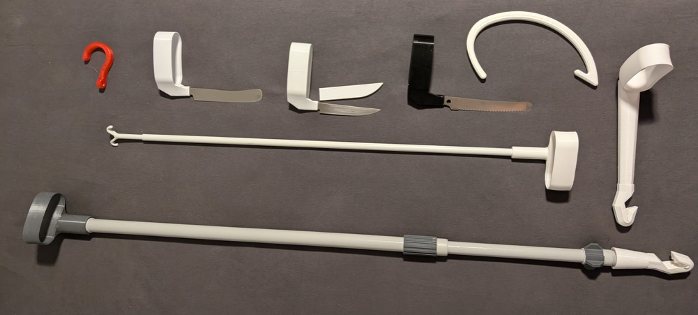
The growing availability of digital fabrication tools like 3D printers and laser cutters opens up even greater possibilities for people with disabilities to design and build their own assistive devices. Online platforms already showcase countless clever 3D-printed “helpers”—proof of the enormous creative potential within this community. We refer to these objects as Access Hacks: inventive reinterpretations of everyday objects and materials that help reduce or remove barriers.
We present a list of current databases that provide downloadable files and instructions for 3D-printed tools, mixed-media projects involving various materials and technologies, and affordable, low-threshold DIY assistive technology (DIY-AT) ideas. Each resource includes short descriptions, guidance for use, notes on potential access barriers (e.g. paywalls or subscriptions), and highlights from notable collections.
Resources for 3D Printing
There are various open-source 3D-printing websites and databases available, mostly for private manufacturing and hobby use. 3D-printing is also a common tool for creating DIY-AT because of its affordability, flexibility and ease-of-use.
The following table provides resources for primarily 3D printing assistive devices.
| Resource | Type | Description | Usage | Free and Open? | Notable Collections |
| Thingiverse | Website/Database | mostly 3D printable files (sometimes additional materials is needed), usually files are given for 3D printing, sometimes additional description for assembly if needed. | search via search bar (e.g. assistive device or specific tool) or browse collections | downloadable, free, no subscription needed | Assistive Technologies |
| Printables | Website/Database | mostly 3D printable files, (additional material may be needed) | search via search bar | downloadable, free, no subscription needed | Assistive Tech |
| Maker World | Website/Database | mostly 3D printable files, (additional material may be needed) | search via search bar can be filtered for print time, print profile, license and more | mixed, some files are downloadable and free, no subscription needed, but needs captcha to access download, others need subscription | Access Hacks; Medical Assistive; Pill Organizers; Adaptive Devices |
| MakersMakingChange | Website/Database | mostly 3D printable files, (additional material may be needed), intended specifically for sharing assistive devices, also has a printing service initiative | search for keyword in search bar (all things are intended as assistive devices), can filter by disability type (arthritis, hearing, vision,… ) | needs account and login to download files | further resources on 3D printing in GitHub: 3D print resources |
| Cults3D | Website/Database | mostly 3D printable files, (additional material may be needed) | search via search bar | mixed, some files behind paywall, some accessible with account | |
| Thangs | Website/Database | gathers things from many diverse sites (Thingiverse, printables etc.) but also allows for direct upload of things, mostly 3D printable files linked | search via search bar enables search over multiple platforms (can filter by websites) | dependent on where thing is linked to (see other websites), for things uploaded toThang directly an account is needed to download |
Mixed Media Hacks
There are also databases available, which provide instructions and projects apart from solely 3D printing. This can vary from simple image-guided instructions for DIY-AT, up to technically complex alternative input types. It is important to note that some hacks are unlikely to be implemented by the end-user. Here, the focus needs to be on co-creation and inclusion of the end-users even though they may not implement it themselves.
| Resource | Type | Description | Usage | Free and Open? | Notable Collections |
| Autodesk Instructables | Website | given instructions and pictures for assembly, partly 3D printables but also other instructions, mixed very simple things (to make) but also quite complicated ones with electronics | search via search bar | free detailed instructions with pictures and step by step descriptions, not necessarily shared files (e.g. for 3D prints) | Disability Aids; Assistive Technology Projects |
| Equipt2Adapt | Website/Blog | low level and low-tech hacks (easy, cheap equipment, quick assembly) | website is not very accessible, not easy to find the concrete hacks | free instructions, free descriptions | Overview of all DIY Posts; Blog articles for specific situations: Cellphone hacks, Computer hacks, Make-up hacks |
| OpenAssistive | Website/Database | quite technical database links to some projects on e.g. thingiverse or github projects (some links do not work anymore) tech-savvy website, not suitable for inexperienced users | search via search bar, difficult to find things, best to search for tags, links to many things are not working anymore | mixed, project dependent, many links do not work | Notable Tags for assistive Devices |
Print Services
Apart from users producing their own DIY Access Hacks, and care workers, friends, relatives or physiotherapists creating the necessary devices, there are also volunteering options. There is still a gap between the need of DIY-AT and its accessibility, especially because of limited access to 3D printers, lack of technological know-how and cost barriers. Community-based AT is one approach towards reducing this gap. Therefore, we include the following websites, which provide print services. These services are free or low-cost and mitigate the necessity of personal printing tools.
| Resource | Type | Description | Usage | Free and Open? | Notable Collections |
| Access3D | Website | Print Service for Australia and New Zealand (for shipping) | account needed for using services, | Links to 3D- printable accessibility device designs | |
| MakersMakingChange | Website | Print Service available (community based), design challenges get posted that can be accepted by makers | accept design challenges, or requests for printing specific exciting thing | account needed for making/posting design challenges, recipient pays shipping costs and material costs |